
Many challenges hinder our development in tennis and unfortunately the industry as a whole continues to lag behind other sports in developing methodologies that demonstrate proven metrics in advancements in technique, tactics and ultimately match play results.
One glaring challenge is the lack of contextual teaching we have in the sport. Static feeding dead balls from a basket from no-mans land to, videos that assume you are playing from a static position or hitting a fed ball unfortunately lack the contextual teaching that is required to achieve higher levels of tennis.
One example of this short coming, is how the slice backhand is generally taught. Foundational technique is important, as are fundamental and understanding the grips and general swing path are prerequisites however, the instruction often omits very key contextual details that require technical tweaks in live match/point situations. Often these prescriptive explanations are simply wrong. Personally, I don’t see the finish below from a well followed YouTube instructor, very often in the over 100 college tennis matches that I’ve seen live nor the many high level junior tournaments that I’ve been to: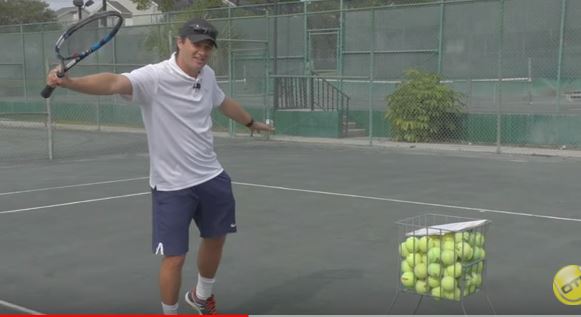
Some of the best visual learning can be attained from watching NCAA D1 college tennis. All of the elements required for good technique, present themselves in context many times during the course of a quality dual match. The situation, the score, the dynamics of a point, joint angles, swing path, racquet head speed, grip, spins, footwork are all right there to be consumed from a front row seat. Top 20 NCAA D1 tennis players rarely make tactical mistakes, you can almost universally screen grab

any point and learn something. The point above includes two backhand slices, however the technique is different, swing path is slightly different, the context is different. One might argue that the last point is a backhand volley…isn’t that a backhand slice? That is the whole point in this article, prescriptive tennis teaching isn’t very useful. In the point above, the approach shot is slightly inside out backhand slice, the key objective is to hit the inside of the ball, keep it low and it should slice slightly from right to left and force the opponent to hit up and on the run. The finishing point was also a backhand slice but a cross court angle achieved by hitting the outside of the ball by hitting a little more in front and slightly more closed shoulder position. Can you see the difference? The inside out backhand volley is an important skill, however it is rarely discussed in the context of the development of the overall volley skill. The reason the inside out backhand volley is important, is very typical for a right handed player to approach by hitting to his RH opponents backhand corner. A down the line pass is the less preferred passing shot, this being able to receive and direct the backhand volley inside out to the open court is a key skill to many approach shots. The technique is a bit different from a normal backhand volley down the middle which is what is often taught.
This is just some examples of how the same shot can have multiple contexts, technique, footwork (even in the same point).
Here is a list of other examples (skills) of the backhand slice that need to be practiced and the technical nuances of each situation understood:
- Backhand slice return (Kick serve)
- Backhand slice return (Lefty wide slice serve)
- Backhand cross court drop shot
- Backhand DTL drop shot
- Inside out backhand slice -baseline
- Inside out backhand slice -volley
- Running defensive cross court BH slice
- Backhand overhead slice
- BH slice lob
Do you practice all these scenarios when you are working on your backhand slice?
In the future, I’ll add links to the above bullets and add the variants required for these different scenarios. I hope you know understand how context can often be just as important as the technique of a tennis stroke.
 Find Your Game