Featured

Learning the sport of Tennis

Are you looking for a new sport or activity or kids looking to participate in tennis as a school sport? You’ve come to the right place.

Here at Waxhaw Marvin Swim and Tennis, we provide private lessons,  clinics and summer camps.

There are two main approaches to teaching tennis, the American Development Model which most instructors in the US follow and GBA, Game Based Approach. TDI blends the two approaches in our group classes and our private classes to provide the best learning environment.

TDI also provides digital content along the way, to help the players and parents avoid all the misrepresented Internet content on TikTok and Instagram. Our digital content is currently provided at no cost to our participants.

For most players, a blend of private lessons, group lessons and small group training is the most efficient way of training and learning tennis. TDI provides options for all levels and ages of players from about 8 years and up. We even provide summer camps.

In addition, TDI can also provide a Digital Development Plan for your aspiring player. For more information, continue reading:

If your junior tennis player has goals to play tournaments or on a school team, you really should consider having a professional coach create a tennis development plan. Too often, juniors are attending tennis classes, private lessons and playing competitive matches with no road map as to how they go from their current level to the next level

A Digital Tennis development plan will include benchmarks to document a baseline of tennis skills and athleticism and agility. The plan needs to include both technical and tactical interventions to stay on a developing trajectory. While not required, we find it beneficial to find technical models for the major high level skills: Forehand, Backhand, Serve. These models will help the coach and the player align on the specific drills and focus areas. While aligning to a model, there will also be a lot of game based benchmarks that will allow the coach and the player to assess the outcomes from the training.

We use video and images in our development plans to compare and convey technical intervention. This helps the players visualize the technical gaps and tactical gaps. Often very simple things like unit turn timings can be better understood by use of video. The models will be selected based on the current skill level, goals and identity of the player as well as physical attributes. Obviously John Isner has an incredible serve, but using him as a model may not be the best considering his contact point will be much different from anyone under 7 feet tall.

Here is an example of a slice backhand model that we might use for a player:

As a coach, we would take special note of the preparation, the footwork, the joint angles, the contact point, the posture, swing plane, swing trajectory. These dynamic gif models provide so much more that static pictures where coaches just used to focus on Grips and stances. Things are much more dynamic now and you must consider things like “Contact Footwork”…the dynamic movement to and through the shot.
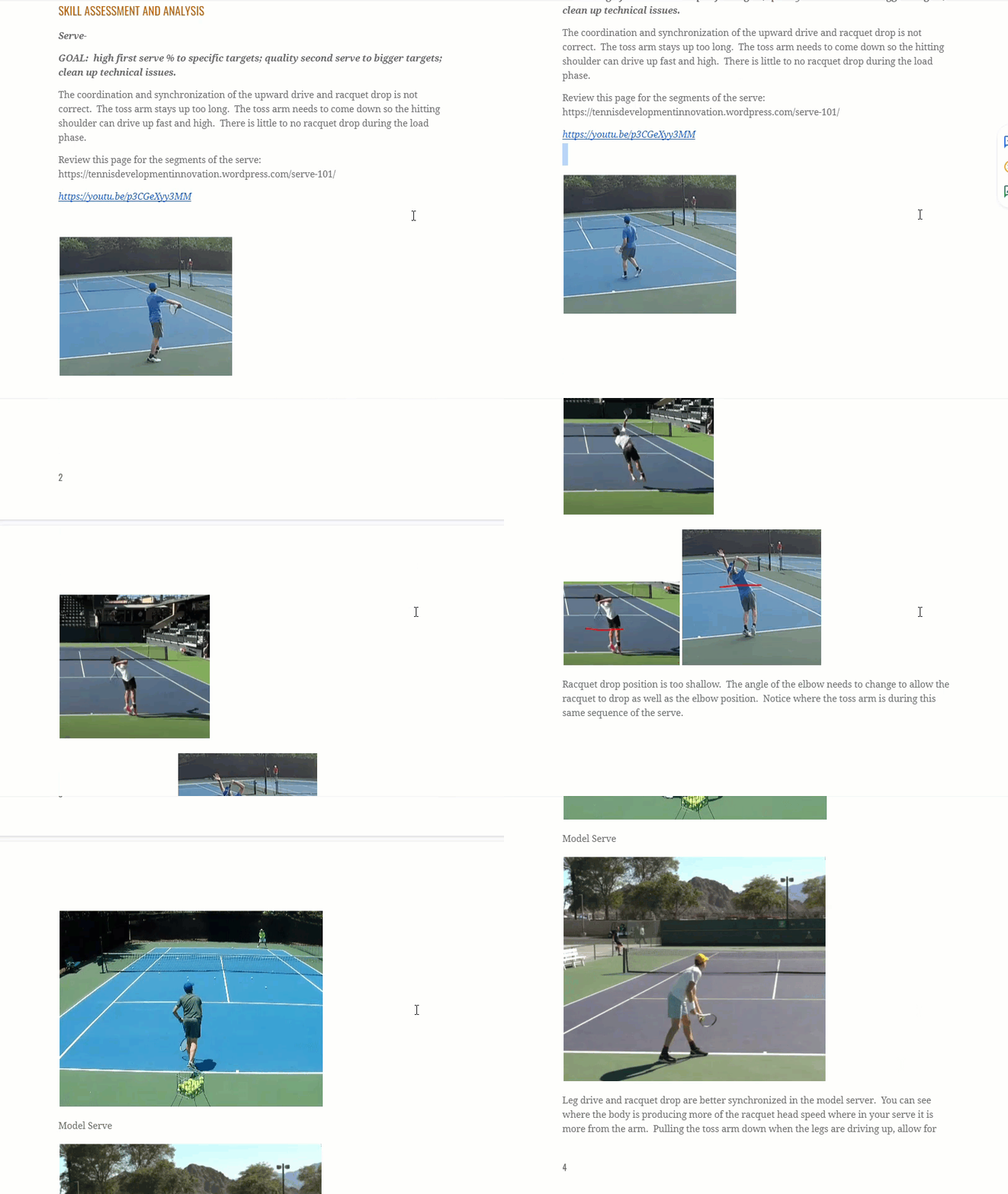
Plan Example

The development plan would highlight the technical gaps and offer intervention and a plan to close them. We have identified about 40 skills needed to play at a high level. We would address all of those skills along with tactical awareness to increase the development trajectory.

The parents, kids and coach are accountable stakeholders in the plan. If you would like to learn more, please contact us for a 1-1 discusion.

Pickleball Return of Serve Footwork Patterns

The return of serve is arguably the most important shot in Pickleball. The return can set up how you play out the point from a return side perspective. A short return can put your team on the defense and allow the serving team to control the point. A high deep return can keep the returning team in an offensive position. Regardless of the outcome of the return, the returner needs to made a serious effort to transition to the NVZ. The return needs to be thought of as a transition ball and players will be ahead to consider proper footwork for the return to assist them in getting to the net quicker and more on balance to defend the NVZ.

There are a few return of serve footwork patterns that even intermediate players could improve. You have a couple basic goals in returning serve. #1 make every return. Deeper is better. #2 Transition to the non-volley line. Sounds easy right? With each scenario, there are certain footwork patterns that help facilitate the return more efficiently and more coordinated. Each scenario or pattern is predicated on the serve. In other words a serve into the middle of your side would require a different footwork pattern than an out side serve.

Regardless of the serve, there are a several foundational footwork patterns that every player needs to learn. Load pivot, hop step, transfer step and cross behind step are the most common patterns. These four represent common scenarios where you are moving forward but need to “move through” the shot while staying sideways (Hop/cross behind) or moving laterally and forward at the same time (transfer step) These demos will give you an idea of the coordinated move for each pattern. You will want to collect your balance and load on your outside foot, and “hit, step” to transition. You don’t want to run through the shot, just be in a position to move forward after the strike of the ball. The key to being successful in these patterns, is coordinating the swing and the step together. Examples of the four:

Hop Step- Neutral ball
Transfer Step- lateral step out (wide serve)
Basic Pivot and Run

Now, go practice these on your own with a friend, or just drop feed to yourself. Video yourself to analyze how coordinate the motion is. The goal is to try to beat the third shot to the NVZ.

Serve Contact Point

Coaches, stop telling players to serve at “1 0’clock”. This is confusing and not accurate.

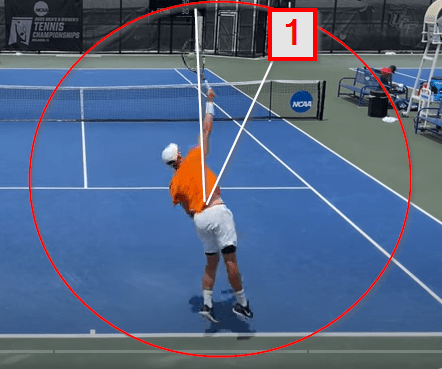
A very common tennis teaching comment is “Serve at 1 O’clock” when referencing the serve contact point. The concept is understandable and can be useful, however it is not completely accurate. A better comment would be to say is “contact is over your hitting side shoulder”. This accomplishes two things. It gets the north – south alignment correct and the east – west alignment correct. If the contact is over the shoulder, this prevents the contact being too far in front of the pivot point of the swing, which causes a downward hit and subsequent open racquet face correction. Both of which are improper techniques. While you can serve like this, you are very limited in being able to hit angles and spin.

Also, if you refer to a clock, it is better to assume the hand is the center of the clock and clearly, 1pm is not the time at contact. 10 or 11 is more appropriate for the serve. The right side of the clock is forehand contact points for right handed players.

Using the body as the clock center, you can also see this is not correct. 1pm is way too far to the right, regardless, the contact should be over the shoulder and not referenced by time on a clock face. When players think of 1 o’clock, they often use forehand grips and make contact on the right side of the handle which prevents the upward and outward motion of the serve.  Unfortunately, a lot of new players get in this position resulting from poor instruction. Breaking this habit can be difficult once muscle memory is established, making intervention more challenging. To correct this, we typically start with very basic motions that send the arm upward and outward and use progressions to get into the correct motions and contact point.

If you are not sure if you are in the correct position, send me a video of your serve and I’ll be happy to provide a one-time free analysis.

Coach Kyle

What is Open Play Pickleball?

The growth in pickleball is on an explosive trajectory, in part due to it’s social play format. Unlike tennis, where it is common for only 2 or 4 players to organize a match, pickleball is often played in what is know as “Open Play” formats.

Open play is a casual, recreational play format where groups of players, often more players than courts available, show up at a designated time and play and rotate partners over a 2 hour period. When there are more players than courts, players will “paddle stack”.

“Paddle Stack” allows more players to participate than the capacity of the courts. As players finish games, they stack their paddles and wait until a court opens up. This provides players a little break to socialize and get water and since games are only about 10 minutes long, the waits times can be a nice break between games.

Open play formats are pretty common just about everywhere in the country now. In the early days of Pickleball, the open plays were typically held inside gymnasiums at the local YMCA or community rec center and you might have used a signupgenius to register. Today, you can find a couple variations of open play events. The most common open play pickleball format are those held at public park facilities. Often, these are just show up an play formats at a designated time. Some, may have online platforms where you need to register in advance to avoid too many players or to limit play to certain skill levels. The other open play option is organized by an organization or private club. These are typically “paid” programs and require advanced registration and payment on platforms like CourtReserve. While many of the public open play events are free, it can be a box of chocolates in terms of participation and skill levels. The benefit of paid for events is you will have a better idea of how many players are participating and it is a bit more restrictive on skill levels. While most of the the private clubs are member only facilities, it is common to allow guests to come to open play events for additional daily fees to help attract new members.

Finding public open play events can be a bit tricky unless you are a savvy social media stalker. One of the big challenges in pickleball, is the fragmentation and growth pains of the sport. Since there is no true leadership or organization at the national level providing platforms and programming, it is the wild wild west when it comes to organizing open play. Unlike Tennis, where the USTA is the defacto standard for leagues and tournaments, Pickleball is an unmanaged sport, where the players and clubs create the local programming.

Note that the playing level often starts around 2.5, which is a level of a recreational level. These ratings are derived from NTRP tennis ratings and in reality most players are “self rated” which leads to a lot of subjectivity in the ratings. Unless you play tournaments, you likely don’t have an official rating, just a guideline based on what your coach rated you or based on your social and recreational play.

To maximize your play opportunities, players should attend clinics and private lessons until they reach around a 3.0 level (subjective). Before attending any open play events, you should have these minimum skills : get your serve in 90% of the time, return serve 90% of the time with your peer level group and make your third shot 80% of the time. I put together a page that highlights many of the skills that are prerequisite for open play. https://tennisdevelopmentinnovation.wordpress.com/pickleball-group-classes/

Beggining players and intermediate players are ahead to refine and hone the basic sending and receiving skills of the first 3 shots. This video highlights those skills required for the first 3 shots:

First Day Pickleball skills

I’ve attached a few YouTube clips below of players that are in the 2.5 – 3.0 level, to give some baseline to what those skills look like in a live play format. Each video is only about 5 seconds and I’ve included those clips that represent beginner level.

4 shot rally – 2.5 level
6 shot rally – 2.5 – 2.75 level
10 shot rally 2.75-3.0 level

In summary, open play is for players that understand the rules, the scoring, the etiquette and can play at a level similar to the above YouTube clips. The great thing about pickleball is that you can learn these skills pretty quickly and there can be minimal investment in formal instruction, however I highly encourage regular coaching to avoid picking up bad habits and incorrect technique that might slow down your development. Players will learn a lot from just playing and supplementing your play with a trained coach. Formal training can help you learn the game much faster and open up more opportunities to play. And I’ve found that players that are winning, have more fun 🙂

If you have any questions or would like to schedule a private lesson or clinic, just click this link

Tennis Coaching is a Scam !

When will coaches evolve beyond the old coaching methodologies that limit the learning trajectory of our young players?

Tennis is an open skill sport. It requires the players to read, react and adjust to the incoming ball, all the while preparing for a forward swing. Unfortunately, the majority of coaches teach Tennis like the ball is stationary. They organize students in lines and have them stand on little circles. The coaches hand toss balls to the players and everyone celebrates when they hit the ball over the net.

This is not the best way to develop our players. Although it creates a happy and fun and environment for success, we aren’t doing any favors to the kids or parents by ignoring the fact that tennis is a movement sport. Those kids that are standing in a line, should be playing instead of waiting. Why do we tolerate this method of coaching?

This old approach to tennis coaching does one thing. It maximizes the revenue per court by getting lots of beginner kids on the court. Are they learning tennis? Yes, but they are falling behind every week by not training using a more game based approach like they teach in Europe. In Europe a more game based approach is used, allowing kids to learn by playing rather than following a prescriptive description of “how” a tennis ball is struck.

Why Traditional Tennis Coaching isn’t working

The reality is that the striking skill is the easiest part of tennis. The most challenging part of tennis is the ball receiving skill which requires the players to read, react and organize their feet in an efficient manner to set up the striking skill. Most beginners will have very little difficulty learning how to hit a ball over the net, however, they will struggle actually playing the sport. The struggle is due to the emphasis on the striking skill rather than the movement and receiving.

In a future article, I’ll address the game based approach to tennis that we take at TDI. Tennis is hard, so let’s make every effort to get our kids playing as soon as possible, otherwise they will perpetually attend clinics and burn through your cash without learning how to play the sport.

The (YouTube) coach below is promoting a teaching device that is not going to help beginning players. In fact, this trajectory is going to create problems that coaches like myself get the pleasure of fixing. But guess what, this coach has made thousands of dollars selling this device to parents and players who just don’t understand tennis development.

It is finally time that we demystify the sport and get our kids on a pathway to learn the sport. The snake oil that coaches attempt to sell to the masses are comical.

Game based approach teaching is a more dynamic approach to learning tennis where the players play mini-games with target objectives in a more live ball setting. This approach requires them to move and hit and learn how to coordinate their body while also learning tactics and strategy.

If you want to learn more about the TDI approach and how we train, please contact us using the form below.

← Back

Thank you for your response. ✨

Warning
Warning
Warning
Warning.

Why is tennis so hard?

I can be silent no more. At the risk of criticism and tennis coach career suicide I’m going to write this article and discuss why so many players just aren’t getting to a high playing level.

Simply, the tennis industry is set up for mediocre and a fun mindset. One could argue that is the goal in tennis right? Learn a new sport, play and have fun. This is true for most and there lies the problem.

I coach for a competitive high school team, competitive meaning state championship level. We run our program very different from most. It is not a development program, it is program that promotes a winning culture. You win at the high school level and college level by creating match up problems across the line up. Our focus through the season is on improving our line ups at every spot, from one doubles to 6 singles. We break down technique to a certain degree and we do a lot of tactical awareness, even using video for technique and post mortem match analysis. We take tennis serious at the high school level because winning a state championship is something 99% can’t or won’t achieve. Reaching a recreational level of tennis is achievable by most and that is the difference between a tennis club and our program.

For specific examples, I have video from some matches of good players, good recreational players and I note a lot of technical issues that we wouldn’t ignore but at the club it will not get corrected because it is good enough for a recreational level, however it doesn’t hold up under pressure and when using new balls. Many kids don’t understand why they can’t control the ball in match situations, but they look like rock stars at the afterschool clinic. It is a few things really. New balls are very different from that cart of old balls at the club and if you constantly train at the club and receive basket feeds you will likely have some trouble transitioning to new balls. The one or two degree change in racquet face can be the difference in a ball landing in during clinic and landing well out in a match. Anxiety plays a factor too and it gets compounded when players start losing control because of the new balls. Technique and fundamentals are a big factor as many players have good enough technique to be recreational level but that doesn’t hold up under pressure and the “country club” ball that you hit at the clinic just doesn’t win in matches and most aren’t trained well in defensive skills. This all results in a player that looks okay but just doesn’t have the ability to grind through points and trust their mechanics. I feel bad for so many of these players (and parents) because if they had been trained to win, versus just look okay and play recreational, they could have become much better players.

Do you see the issue here? Most coaches will not because he checks the boxes they ask like, Racquet back, racquet below the level of the ball, swing low to high etc. I see this exact same issue all the time. As kids move from MS to HS they continue to play with an open racquet face and as their bodies get bigger and they can swing bigger they actually lose more control. If they are trained from a basket of dead balls, this technique probably works well in the clinic. The biomechanics of how the arm and elbow work, going from the unit turn to the forward swing, suppinates the forearm. This forearm suppination sends the palm upward. In tennis we don’t want to have to mechanically rotate the palm downwards into contact, that would be too difficult to control, so the palm needs to be pronated more on the unit turn to accommodate the suppination during the forward swing. All this narrative means, is that this player, along with many others has an open racquet face into and through contact, combined with an upward swing path and there is no way he can control this ball and worse yet, he has no idea because I’m sure no coach has ever told him…until now.

Two very significant issue can be spotted immediately by a trained coach. First, the racquet is completely open, with the palm up during the serve. This works in 10U tennis but as kids get older, they cannot serve and control the ball with an open racquet face, nor can they try closing to contact. The backhand was missed because the player clearly hasn’t been taught that the the left foot is the key foot to land for spatial distance and alignment, and not the right foot. This player landed the left foot in a random spot, then used the right foot for alignment and ended up being too far from the ball, and missing in the net.

More evidence that this player has never been told to align the left foot to the incoming ball on the backhand side, which will result in a lot of inconsistency.

There are so many ways to play tennis at a decent level and I think many coaches are trying to do the right thing, however so many kids (and adults) would be better off learning to control the ball with more basic strokes and more conservative grips, than learn more modern mechanics once they reach a decent recreational level because what I see is the modern teaching is actually causing levels to go down for many players that just can’t control the racquet face and don’t have good recognition and receiving skills. This contrarian view can be validated when you see many adults that still play old school and would have no trouble winning against most high school players because they have good awareness of the racquet and also good tactical minds on how to win. They don’t look good but they can play. As players emerge above a recreational level, a highly trained coach can help them get to elite levels with more modern techniques because every player will always need to have skills to counter punch, play defense and hit flatter trajectories. The old school skills are still required in some situations, even at elite levels.

Every.Single.Player. Should have video and study their match play to better understand how simple the game can be and after watching I think many will realize they simply need to play more and spend less time at the clinic with some regular check in with a qualified coach either online or private on court. In our digital world that we live in today, you absolutely can get value from a coach helping you online and I’ve even done this with local players.

Home Tennis Training

We offer a great solution to busy parents that want to get their kids involved in tennis but don’t have time to cart them to the club or wait 2 hours. We bring the tennis training to you.

Our innovative approach to tennis training starts with our home tennis trainer and a progressive teaching method to the most common tennis strokes, forehand, backhand, serve, volley. We incorporate drills to learn the proper contact footwork along with the stroke mechanics. We can setup in your driveway or garage for a one hour session.

Tennis Trainer in Garage

We have a proven and innovative approach unlike most programs that end up taking too long to get kids to a rally stage. We start with a simple hand rally to get the basics of sending skills. The technique here is in line with a proper tennis stroke and starts with a unit turn (pivot) and extension of the arm from the rotation of the torso to the contact point.

Our next progression is really where the kids start learning the mechanics of the tennis stroke, which is placing the palm behind the strings and sending the ball with two hands. This approach is unique to our methodology and yields quick results. We focus on the unit turn and a slight angle of the shoulders to get the racquet going upwards through contact. Notice the finish is above the shoulder and the motion through contact is upwards and outwards.

We progress to a two handed forehand which is very seamless from the palm on the strings. This helps the students maintain that proper palm position during the striking phase of the stroke. The same techniques are used as the first two progressions.

We look forward to working with your kids and developing the next tennis star right at your home!

For rates and availability please contact us using the form below.

← Back

Thank you for your response. ✨

Warning
Warning
Warning
Warning.

When is your kid ready for tennis lessons?

Playing tennis requires very good hand, eye, feet coordination along with agility and reaction skills. For many, the tennis development process starts well before those foundational skills are present. Most all kids can learn how to strike a ball from a static position the very first day of tennis lessons. What most don’t realize is that the striking skills are arguably the easy parts of learning tennis. The more challenging parts are involve the receiving skills: reading, reacting, positioning and contact footwork. Unfortunately the majority of coaches teach tennis like it is a golf lesson. Golf is a closed skill sport, and tennis is an open skill sport. Tennis requires dynamic movements for receiving and sending. These dynamic movements put a premium on coordination. In my experience, many kids enroll in tennis lessons before they are ready to learn these dynamic movements and tennis becomes limited to a “golf lesson”. These static skill developments are fine and certainly required, however paying a professional instructor to hand feed is not the best approach. I have many drills on my website that parents or peers can facilitate on their own. I recommend all new players start with this page.

My normal warm up drill is also a very good benchmark test for kids. If they struggle with this coordination drill, maybe they aren’t ready for tennis:

Warm Up Coordination Drill

Notice in this drill there is a ball in her hand and I’m tossing a ball. The player must catch the ball with the hand that the ball comes to. ie. left side, left hand; right side, right hand. If the player is holding the ball in the right hand, and the ball is tossed to the right side, the player must transfer the ball to the left hand and catch the other ball with the right hand. The player must stay low and wide and push off the ground to move and track the ball all the way to their hands to catch it. The player should avoid lunging and reaching. The goal is to position the feet correctly and stay balanced while tracking the ball. These are important skills for tennis.

We are looking for kids that have enough hand, eye, foot coordination to perform a non-technical rally. Essentially send and receive the ball with just basic technique like below:

We will work on more appropriate footwork and swing mechanics to develop better sending skills.

My team excels at providing a balanced approach, with an ultimate goal to get everyone actually playing the sport. We incorporate a balance of technical skill development with goal oriented training. We also provide online content to accelerate development and self learning.

Our methodology includes a balance of private, semi-private, group and self training with online content. I encourage parents to support this approach and have an active role in the development. Practice needs to be prioritized along with self learning. We find that kids that are around 10 years old are mature enough to follow this approach. Prior to this age, we recommend other activities that build Hand, eye, foot coordination like playing catch or soccer or dance or gymnastics. Once a good foundation of throwing and catching skills are developed, tennis may be a good transition. Until then, continue to work on coordination skills at home or through other sports and activities.

Learn the Basics of the Serve in 30 minutes

In this tutorial video, I demonstrate how to learn a basic tennis serve in 30 minutes. The goal remains the same for me every day I’m trying to get more people playing the sport of tennis and you can’t play the sport if you can’t start the point. For our purposes, the serve is to simply start the point.

Serve Progression Drill