Volley- Fundamentals and home and on-court Drills

The volley is a ball that is struck before bouncing on your side of the court. Like most shots, it can be hit with topspin, underspin, side spin or no spin. The key is that the racquet face is angled towards the target over the net at impact. It is best for the handle to lead this stroke, in other words be sure the handle of the racquet stays slightly in front of the tip of the racquet through the hitting zone. Your index knuckle should be around 1 o’clock on the grip to allow you to control the racquet face for both the forehand and backhand volley.

Key check points:

-Slight turn of the body

-Keep the elbows in front of the body

-Keep a firm grip and extend the arm slightly to contact

-If you have time, move forward through the volley by pushing with your hitting side foot, stepping with your opposite foot
Tennis Coach Fitness GIF by fitintennis - Find & Share on GIPHY
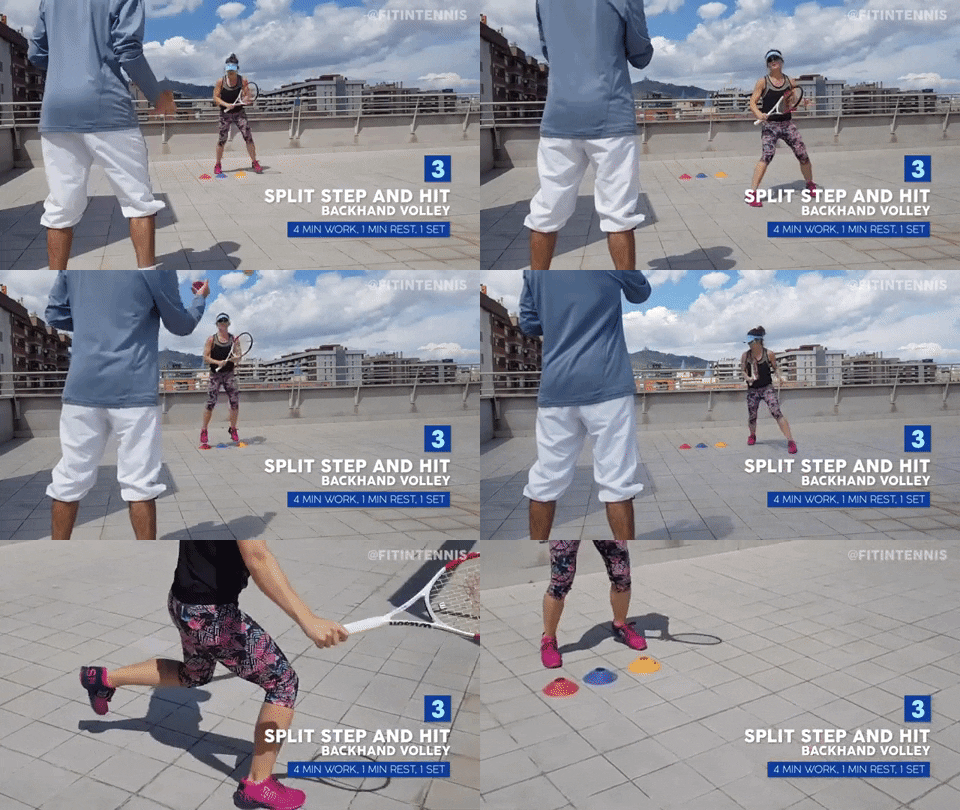
Backhand Volley
Tennis Coach Fitness GIF by fitintennis - Find & Share on GIPHY
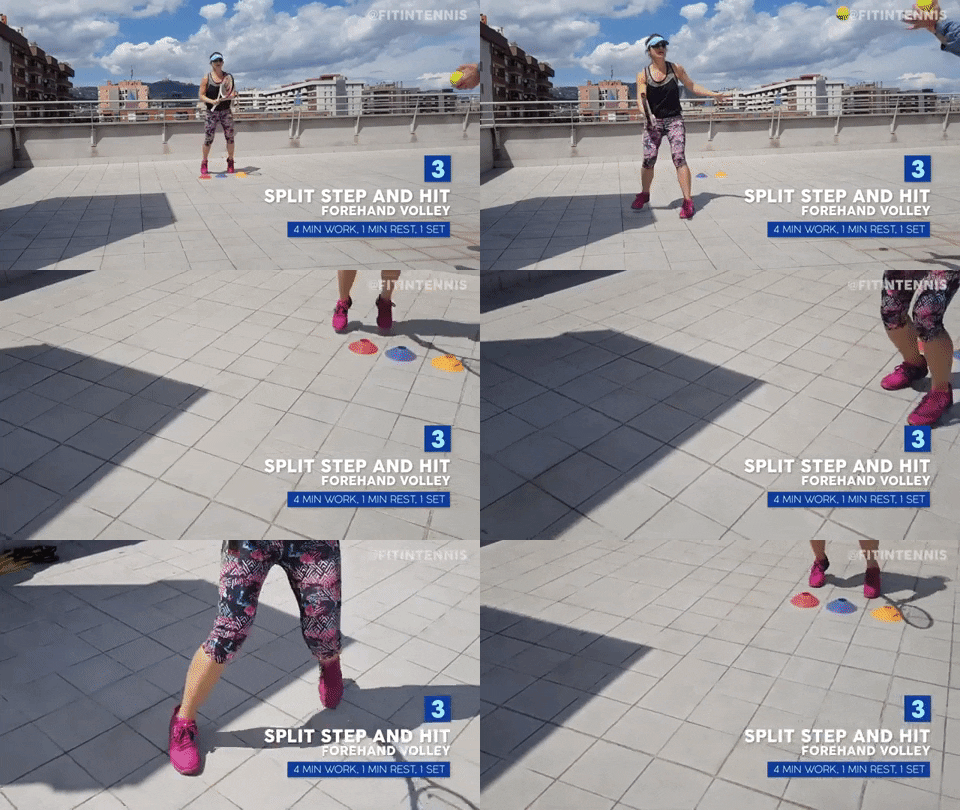
Forehand Volley
Tennis Coach Fitness GIF by fitintennis - Find & Share on GIPHY
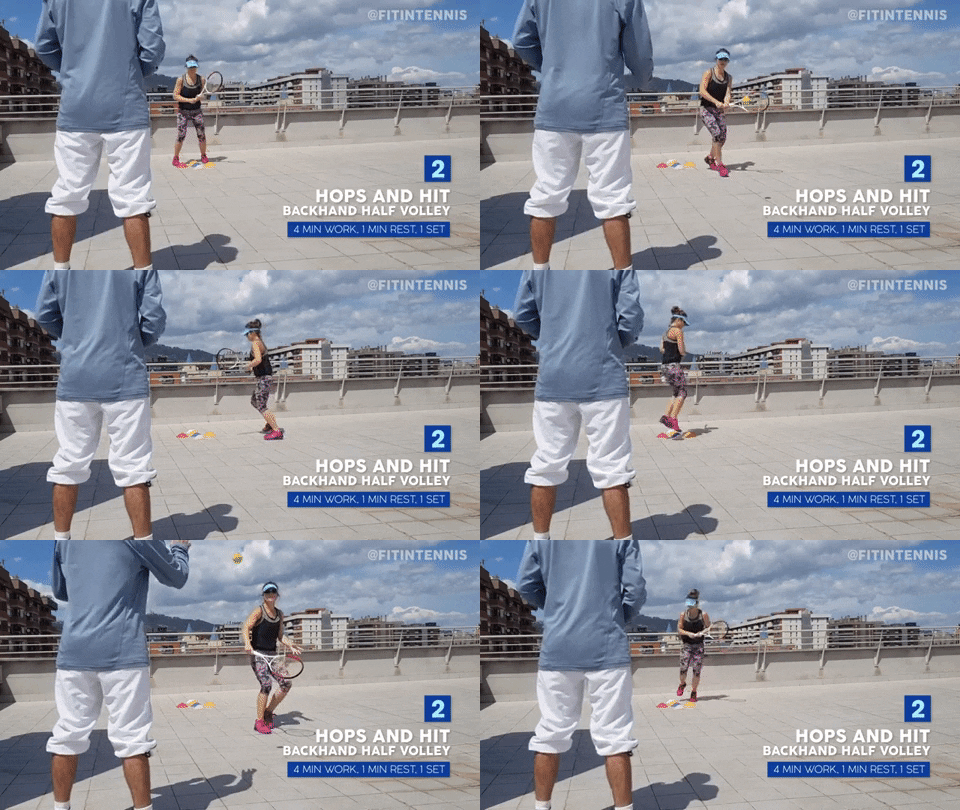
Backhand Half Volley Drill
Tennis Coach Fitness GIF by fitintennis - Find & Share on GIPHY
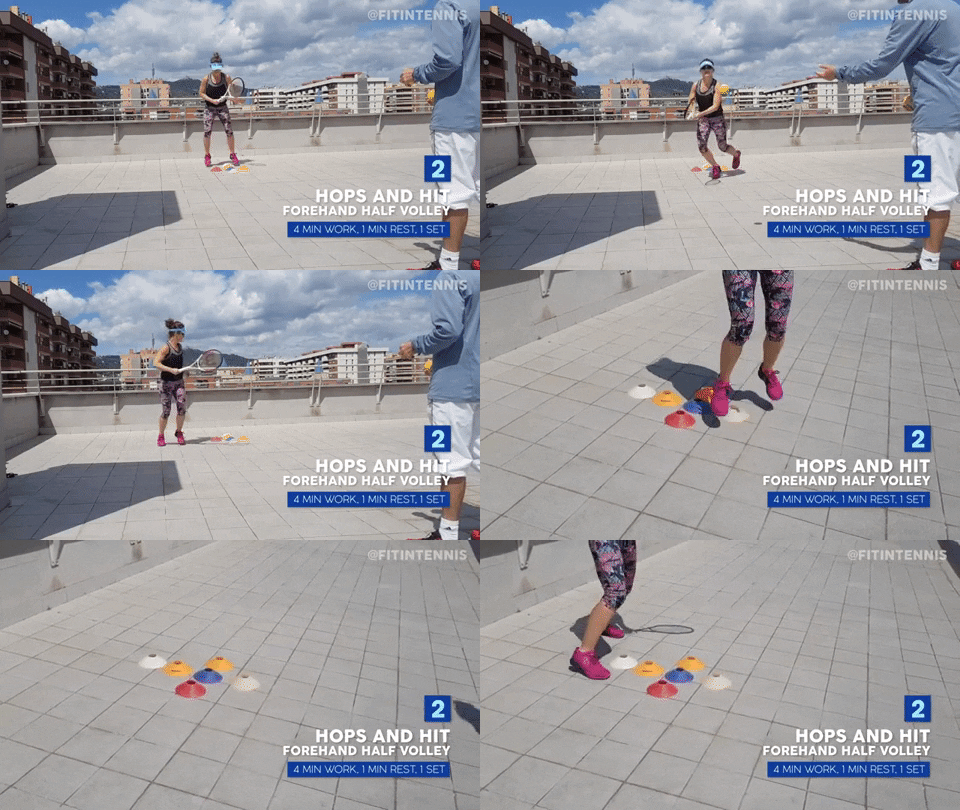
Forehand Half Volley Drill

The best way to train and develop your volleys once your foundation is good is practicing with live ball scenario and cooperative play:

Most coaches make the mistake of basket feeding in volley clinics. While this repetition can be helpful, simulating a live point is the best way to train your volley skills. This means that the volley side should always feed to simulate an approach shot. The volley side should also vary where the feeds go and follow that line to the net to also work on footwork, positioning, balance and timing. Standing statically waiting on a floaty basket fed ball creates an environment that is not practical in live point play.

How not to train volley skills

The best way to train is one-on-one with someone around your playing level that also has a desire to improve their volleys. Be sure that the volley side feeds and the baseline player is being cooperative but also trying to win the point. The point of the drill is to create challenging situations and not make a lot of errors. There is a balance of trying to hit out right winners and hitting cream puff balls to each other. You’ll want to play at a speed that you can make 75% of your shots while challenging your training partner.

Cooperative Volley Drill

The volley is about placement. Placement is predicated on racquet face angle, trajectory and swing speed. Be sure to work on hitting volleys cross court, down the line, short, deep as well as receiving balls with underspin, topspin, with various heights and trajectories. Most club pro’s do you a disservice by feeding the exact same no pace, no spin ball which can impede your development. Find another player to train with and use this approach to improve your volleys.
Disrupting the tennis moonball pattern

Moonballing can be an effective pattern for all levels of tennis in particular using it against opponents that strive off of strike zone balls and like to dictate play from the baseline. However, just because you initiate the moonball pattern doesn’t mean the point starts to tip in your favor. The moonball is a very basic skill and you must assume that your opponent is equally skilled in this tactic.

There are a few ways that you can disrupt a moonball pattern, and they do come with risks. The first is the high slice. Federer demonstrates this very often while returning kick serves to his backhand. The benefit of this pattern is being able to take the ball on the rise, take time away from your opponent and to make them move forward, hit on the run, a ball that is out of their strike zone. The second option is utilizing a high forehand inside out swing, hitting the inside of the ball creating a ball that breaks away from your opponent. Taking this on the rise can be very effective by taking time away from your opponent and also making them hit on the run in an awkward part of the court. When executed well, you can actually hit a winner with this shot.

Lastly, the most typical tactical plan of the moonball, is to out moonball your opponent and force them to cough up a short ball. This is more of the percentage play, but only if you think your moonball, footwork and skills to move forward and create off this short ball are developed to execute this the majority of the time. Regardless, it is good to practice these three patterns and use them in matches when you are face with opponents that are grooving their groundstrokes.

Protecting Your Backhand

A common misconception is to hit to your opponents “weak” side, often their backhand. This is a very basic tactical tennis strategy at all levels. It can work if executed properly, however there are situations that need to be understood or this plan may actually backfire on you.

Any tennis player that has a significantly weaker backhand, is fully aware of this weakness and they have their own game plan to protect their weaker side. Often players will run around their backhand and have set plays to avoid hitting backhands and this is where your well laid out plan may actually bite you.

You see, when you hit to a players “weak” side and you do not put them on the run, they likely will have time to move around and hit their stronger shot. This now creates a problem. Since they are highly skilled in this, from many many repetitions, it becomes their best and favorite shot. To make things worse, you just gave them a cheat code to limit their recovery to that side of the court. Now your plan to break down that backhand, just turned into a losing proposition because not only are they hitting their favorite shot, but now they are playing half court tennis while you are playing full court tennis.

A better plan is to direct neutral ball rallys to their strong side and try to take one of those rally balls early and then hit to their weaker side, putting them on the run to the weaker side. Now they have the dilemma of hitting their weaker shot, but also recovering to defend the forehand side from being on the run. This is a 3 shot pattern that requires precision and patience for the right scenario.

Reading and Reacting to the Balance of your Partner in Tennis Doubles -Unplanned switching

Some doubles shifts are obvious and even though your partner may yell “switch” you need to be aware of those less obvious situations and react without a verbal queue.

There are times when your partner doesn’t encroach into your playing side but their balance from a shot or movement to attempt to cover a middle ball may be best played as an unplanned switch based on the balance of both players.

This can help the team prepare for the next ball and create some disruption and may throw off your opponents. Both players need awareness of this situation and react dynamically and it is often the non-hitting player that initiates the switch by reading his/her partners balance.

You’ll notice the Bryan brothers executing this unplanned shift all the time and you will also see this in College tennis in particular where a player that has a stronger forehand may be aggressively playing into his partner’s side of the court to hit the strongest shot of the team.

Common examples of this scenario involve a ball in the middle where the stronger player moves over to play this ball and both player have momentum in that direction and it would be best to continue in the direction and make an unplanned switch. Other examples may involve a lefty right combination where the lefty is playing on the ad side but will take a ball on the deuce side due to it being the strongest shot of the team. Another example is a semi poach either half volley or volley from no mans land that could benefit from a switch.

Kick Serve Drill

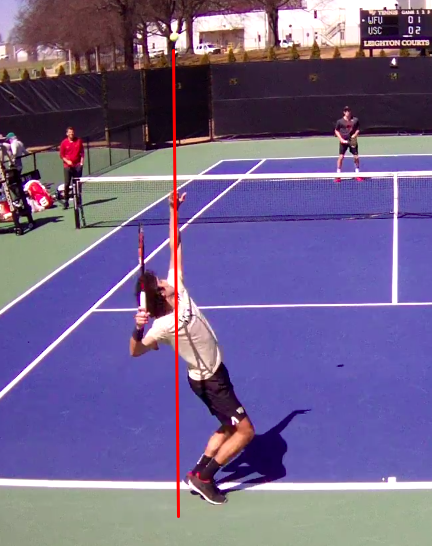
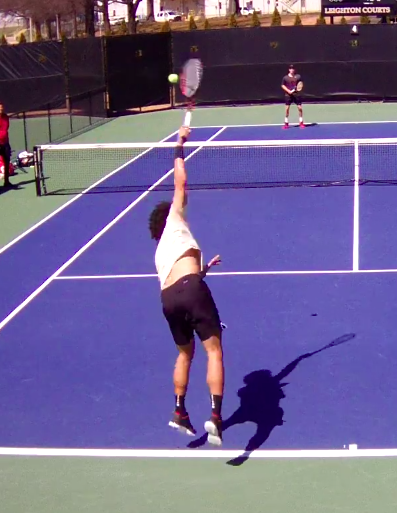
A lot of coaches promote a drastic change to your toss to hit the kick serve. “Toss behind you’re head” is often the instruction. This is wrong!!! You can hit the kick serve with your normal toss. Now understand that many players toss too far to the right to begin with so you may end up moving your toss for the kick serve, however I recommend a toss that is aligned to the outside of your left foot (righty) with contact just over your hitting side shoulder.

Training with an orange ball, with 25″ racquets can benefit you in a few ways. The shorter racquet requires you to hit at a lower contact point which is required to hit “up” and the shorter racquet doesn’t give you as much lever affect as a 27″ racquet which will promote more upward swing path. Also, using the 60′ lines will give you confidence and promote hitting to a smaller, angled target. Be sure to drive those knees over your toes to create ankle/calf flexion to drive up to the ball.

The Modern Tennis Forehand 2.0

The Elements of the New Modern Forehand and what you need to know

It is very common to hear terms like open stance, windshield wiper, kinetic chain, jumping pivot when describing the modern tennis forehand. While these terms may play a role in the modern forehand, they are more appropriately describing what I call the modern forehand 1.0. When we went from linear swings to modern swings, there was a misconception that you the swing became exclusively rotational and the racquet head speed was created from a kinetic chain of biomechanical forces, led from a squat and lift and rotation of the torso.

Example of the Older Version of the Modern Forehand 1.0

These elements, including jumping are used in situations, however the biomechanics that contribute mostly to the transfer of energy and racquet head speed is not from the leg drive. The most simple anecdotal evidence of this is watching any top player rip a clean winner forehand on the dead run. In those cases, there is no squatting, no lifting and limited rotation from the torso. The mechanics of the running forehand apply to most all forehand strokes, including neutral ball rally’s.

I don’t want to confuse you, there is certainly rotational forces and shoulder turn and leg drive, just less emphasized than what many coaches realize. We have an amazing tool in the modern tennis racquet, and we need to use this tool and have it do as much of the work as possible. The top players have figured this out. They look effortless for a reason. The modern tennis strokes are more effortless because the biomechanics are more efficient than what most coaches are teaching.

Modern Forehand 2.0 Technique

The modern forehand 2.0 is more of an independent arm action that loads the forearm and wrist allowing it to release the racquet head during the impact zone creating extra racquet head speed without jumping or excessively squatting/loading the legs. This technique is more efficient and provides better and quicker recovery and frankly has more racquet head speed, control and hits a heavier ball than the jumping two foot pivot technique. Keys of this technique:

  • Unit turn / coil while keeping the elbow from getting too far behind your back
  • The hips and shoulders initiate the forward swing which create the racquet head lag and the 45 degree runway angle of the elbow
  • As the elbow starts to reach its’ full extension, the shoulders should decelerate allowing the elbow to switch from a linear plane to an angular plane releasing the racquet head with forearm pronation and wrist radial deviation
Modern Forehand 2.0 Explained

Tennis is not intuitive

A popular Youtuber with account name “Intuitive Tennis” creates content about the intuitive natures of tennis. While some aspects may be intuitive there are many aspects of tennis that are not intuitive at all. The modern groundstroke may be among those biomechanical anomalies that are require a deeper dive into how power, spin and most importantly control are achieved.

I’ll go out on a limb and state that tennis is not intuitive, otherwise many more recreational players would be much closer to college and pro level players. The skill gap between average college players and average recreational players is tremendous. Potentially more so than most individual sports like golf. I believe that gap is widening too, with better racquets and string technology that favor higher level players.

The modern forehand ground stroke is very unintuitive in how racquet head speed and directional control are created for the average or above average recreational player.

In this short clip, I explain why elbow path follows a 45 degree angle to impact on almost all strokes, regardless of the target. Which is not intuitive to the majority of players and largely not taught by your local tennis coach.

Defending the Second Serve

Serve plus one tactic is most often in the context of first serve made, then put away on the first ground stroke. Arguably, a more important and relevent tactic is the serve plus one on the second serve. A players ability to defend their second serve can very well determine the outcome of the match.

In this example, I look at the 2018 NCAA singles champion, Petros Chrysochos demonstrating the perfect technique of defending the second serve. In this semi-final match, Petros will use his right foot to push back to a neutral position after he lands in the court from the serve, then as he moves laterally and behind the baseline to defend a deep cross-court return, he is able to land his right foot and create wrist/racquet loading quickly to play a first ball back heavy cross court.

The four key points:

  • Gaining balancing and pushing off with the right foot after the serve to a neutral position
  • Efficient movement laterally and back to defend the deep cross-court return and landing that right foot to pivot off of
  • Short and quick wrist and racquet loading to get the strings to the cross-court target
  • Good recovery and balance to set up the run around forehand, inside-in for the winner

Understanding the Lag and Snap

It seems to me that most tennis teaching pros, online or club based, do not understand the lag and snap nor the purpose.

The lag and snap technique is predominately used for controlling the tennis ball. A great example of this would be when receiving a low, fast, skidding slice, more lag and snap would be needed versus linear acceleration in order to control the ball over the net. When receiving fast underspin, the ball tends to skid to you rather than bounce up from topspin. Every ball will have some topspin coming off the bounce, however underspin will negate this effect which requires additional racquet head speed to control the ball, otherwise the outgoing ball will find the net or pop up due to the face angle needed to drive this ball over the net.

The lag and snap is not a required skill to play higher levels of tennis. Your ability to hit targets from your opponents shot variations isn’t predicated on the ability to lag and snap, however it does add an element of offensive and defensive capabilities that could present a competitive advantage.

Examples of these scenarios would be the ability to find short angles off low received ball, the ability to hit higher over the net with more court margin, the ability to turn an on the run defensive situation into an offensive situation such as an on the run forehand.

Quite possibly the biggest advantage of the lag and snap is something profound that your club pro will not tell you and that is the benefit of doing less with your body to get more efficient response from your strokes. Let me explain this a different way…there is too much emphasis on loading, lunging, exploding, uncoiling, using the legs, shoulders, hips etc. to simply hit a 2 oz object about 60 feet. Clearly footwork, body position, bio-mechanics all contribute to a degree to affecting a balls behavior however teaching players to use the tool that they have to most efficiently hit their targets is very important. It is very clear watching many amateur players and juniors that over rotate their body and lag the racquet too long with extreme grips and develop too slowly is a by-product of poor instruction. Many juniors would be better off spending their time hitting on a wall and learning how the tool (racquet) works in a controlled environment without a lot of bogus instruction. Some of the top players in the world exercise these concepts like Federer, Nadal and Djokovic. Other examples that are a bit more obvious of efficient use of the lag and snap while minimizing the overuse of the body would be the French player, Adrian Mannarino, American Bjorn Fratangelo and Australian players Bernard Tomic and Nick Kyrgios.

This video explains a more efficient use of the body to create the acceleration needed to control the tennis ball.

Bjorn Fratangelo Junior Easter Bowl

Francis Tiafoe forehand


The lag and snap concept is the bio mechanical loading and unloading at the correct time to generate racquet head speed which at the correct swing path and face angle generate the topspin that adds behavior to a tennis ball. The snap should not be a forceful use of the wrist or forearm but a smooth and controlled release or unloading of the wrist from an extension position to a flexion with pronotion in the forearm. The key for this to happen is the loading, which requires the correct mechanics of the lower and upper bodies working in concert so that the arm can swing out on a 45 degree angle towards the contact point. This 45 degree angle is the proper path to generate and time the release of the racquet face and is also referred to as “buttcap to the ball” by many coaches or “shine the flashlight on the ball”. The elbow should be comfortably away from the body and the racquet head should start lagging on the start of the forward swing and not during the take back, otherwise this limits the loading and unloading.

The RT Speed was developed to help players create effortless power by allowing the racquet to lag in a simple way be reducing grip pressure and providing the feedback to the player on the timing of the release for optimum speed and spin.


See you on the court.

KW

Passive Wrist Motion on the Tennis Forehand

There are many opinions on the role of the wrist in the modern tennis forehand.  The wrist action is mostly passive and it is important to understand how the joint behaves on an aggressive neutral ball, hitting cross court with spin and margin.  I add this bit of context to understand that the stroke may behave slightly different in varying scenarios.

Some coaches refer to lag and snap as it relates to how the racquet accelerates up to contact.  This term can confuse players, and potentially emphasize too much active wrist in the forward swing.  There is a varying degree of active wrist engagement based on the shot situation.

We need to recognize what happens to a relatively passive wrist during a mechanically correct modern forehand.

While this blog post was in draft form, a video on this topic found it’s way into my YouTube feed.  After reviewing this video, I found that it ironically hit on all the topics that I had planned on discussing in this blog post.  I think this video is very close to hitting on all the points that are important.  I don’t agree on everything 100%, but it is too well done to debate.  Please watch the video in entirety and let me know if you have questions.  There are other videos on this topic and I think this one best covers the topic, however it packs a lot of information in a short video, you might need to watch it twice to fully consume the information.