Tennis Serve Variants and Why They Matter

To  a certain degree, the serve can be likened to a golf swing in that some variants while not technically correct can be effective due in part by your ability to repeat the motion and deliver a consistent and effective outcome that starts the point.

The serve is complex on many fronts, even the mental approach to purpose can get complicated.  Some instructors view the serve as just starting the point.  The goal of the serve is to not make an error and not offer up a short ball…..just get it in, deeper is better and make a very high percentage of first serves.  It is hard for me to argue that approach.  The other approach is to use the serve as a weapon, and start the point of on your terms by developing a fast and well placed first serve with spin, backed up by a second serve with heavy kick or excellent placement.

I suspect that most competitive recreational tennis players fall in the middle of those two mental spectrum’s.  I rarely see league players making 80 percent of their first serves nor do I see many players able to do damage with their second serve.  Often what we end up with are decent first serves with respect to speed, spin and placement that land in 30-45% of the time and relatively lousy second serves that are attack-able, so essentially the worst case of both scenarios.  Most juniors are in this group as well, regardless of their technique, they end up playing the bulk of their matches with their second serve.  The pressure of the match and the lack of repetitions just do not transfer over to the match play from practice where they may be able to hit 70% first serves in.

Is any of this related to the technical variants of the tennis serve?

We must understand that the tennis serve is taught differently and you can recognize this by watching college players, WTA and ATP players.  For the purpose of this article, we’ll focus on two variants, however there are more.  The two most common serve types are the “step-up, lean in” (pinpoint) and (platform) “lean back”.  There are on some occasions a combo variant of “step up, lean back” and you’ll see this technique with Stan Wawrinka, who arguably has a very good serve.

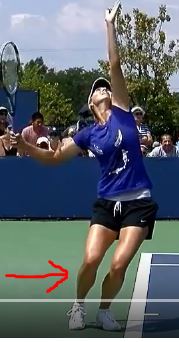
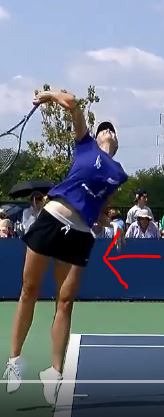
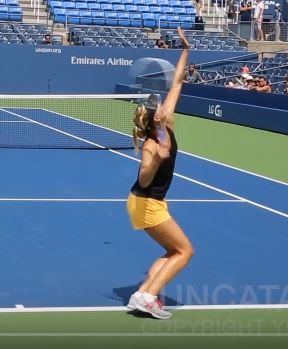
The step-up, is also referred to as the pin-point stance serve where the right foot comes up just before the loading phase of the serve (for right handed players).  Example of Maria Sharpova below:
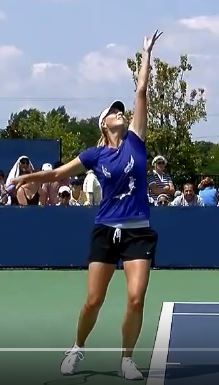
The benefits of this technique is promoting a good hip shift and a good leg loading to allow for a jump and higher contact point and shoulder rotation.  Some players will also benefit from a more coordinated and fluid motion with the pinpoint, step up serve.  You’ll see variants of this approach where some pause at the trophy position like Kevin Anderson, or those that are more continuous like Nick Kygrios.  The continuous motion seems to have more bio-mechanical benefits and is discussed in detail here:

The pin point stance can have a few different bio-mechanical elements related to how the hip moves and rotates during the step up phase. This is very important to be aware of, as these seemingly minor differences can make the mechanics of this serve very different. In general most coaches believe the movement of the back leg forward ads momentum to the serve thus becomes a source of power. I don’t buy this theory as most players bring the foot up, stop or pause and break the momentum. It is in fact the hip movement that creates the loading and unloading that contributes to the power and this will be explained using some player models.

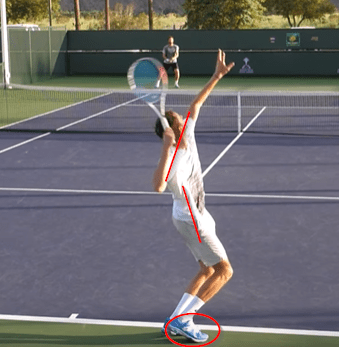
Those players that bring their back foot up beyond their front foot allow the hip to turn a bit towards the target (counterclockwise), while the shoulder rotates the opposite way creating separation angle that builds loading like winding a spring.
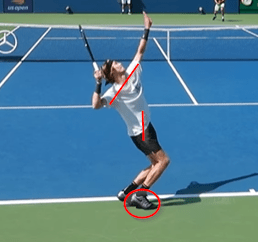
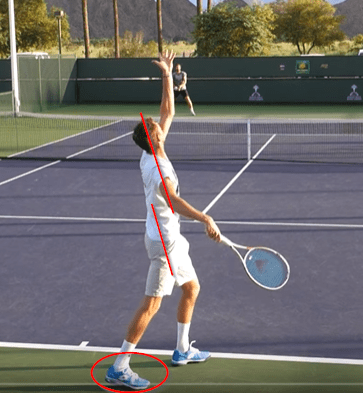
Rublev brings his back foot up, slightly in front of his front foot, which opens the hip and creates separation angle with the shoulders and loading up the core muscles
Medvedev at he start of his serve, hips and shoulders are aligned
Daniil Medvedev loads his core by rotating his hip counterclockwise while rotating his shoulders clockwise winding the spring

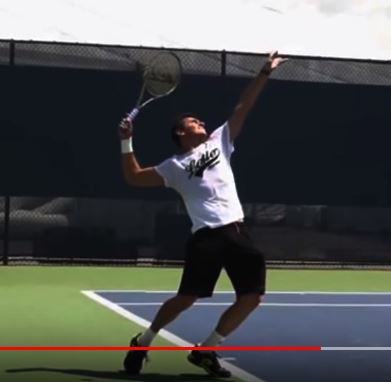
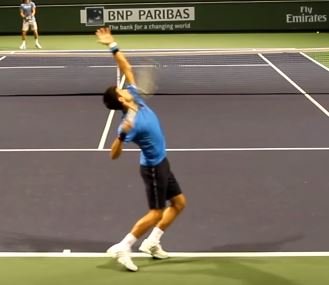
The platform stance is also commonly used and taught and is used by some of the best servers in the world including: Andy Roddick, Roger Federer, Novak Djokovic, Nicholas Almagro, Milos Raonic.  The benefits of the platform include a slightly decreased learning curve due to less footwork during the serve initiation but most of all the ability to support a lean back during the serve.  The platform stance provides the foundation to support a slight lean back to allow your chest to point towards the sky during the trophy position.  It is well documented that swinging across your chest plane is not only more powerful but also is less damaging to your shoulder joint.  Serving across your chest also promotes a more natural coordination of the internal shoulder rotation and forearm pronation.  Leaning back and moving the elbow while the chest is up will facilitate a much deeper racquet drop.  It is important to start the racquet drop during the upward drive and not before.  Dropping the racquet early, before the leg drive can cause you to lose power and momentum.  We want the racquet to drop and drive up violently to create racquet tip speed.
novakserve
Novak with significant thoracic spine extension and some hip/shoulder separation angle
almagro22

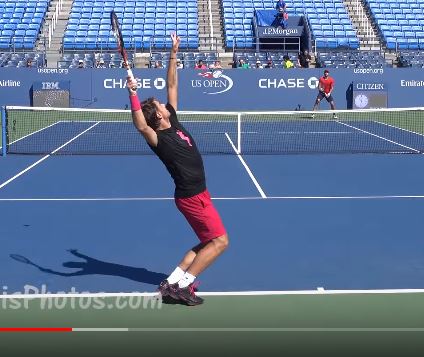
Leaning back is not exclusive to the platform stance however.  There are a number of ATP players that achieve this position with the pin-point stance.  One of the best examples is Stan Wawrinka:
stan22
Stan has some separation angle and is loading with thoracic spine extension
pova22
Maria is driving the hip linear, into the court without any separation angle of shoulder/hips nor the chest up position

For a review of the primary check points to get a baseline of your serve, I created this video:

Mechanical check points of the serve

I suggest that you try platform stance and pin-point stance and see which footwork pattern works best for you.  More importantly, creating separation angle is needed to create loading in the core. This can be achieved in either stance but is likely more accommodating in the pin point stance. Some thoracic spine extension is recommended to get the shoulder plane in the optimal angle to promote the use of “big” pectoral muscles in driving the racquet upwards. In either case, racquet head speed is at a premium for the serve, to create pace for first serve and controlling spin for the second serve.
Contextual Teaching in Tennis

Many challenges hinder our development in tennis and unfortunately the industry as a whole continues to lag behind other sports in developing methodologies that demonstrate proven metrics in advancements in technique, tactics and ultimately match play results.

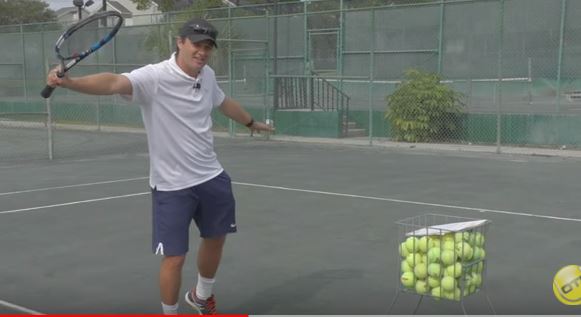
One glaring challenge is the lack of contextual teaching we have in the sport.  Static feeding dead balls from a basket from no-mans land to, videos that assume you are playing from a static position or hitting a fed ball unfortunately lack the contextual teaching that is required to achieve higher levels of tennis.

One example of this short coming, is how the slice backhand is generally taught.  Foundational technique is important, as are fundamental and understanding the grips and general swing path are prerequisites however, the instruction often omits very key contextual details that require technical tweaks in live match/point situations.  Often these prescriptive explanations are simply wrong.  Personally, I don’t see the finish below from a well followed YouTube instructor, very often in the over 100 college tennis matches that I’ve seen live nor the many high level junior tournaments that I’ve been to:bhpic1

Some of the best visual learning can be attained from watching NCAA D1 college tennis.  All of the elements required for good technique, present themselves in context many times during the course of a quality dual match.  The situation, the score, the dynamics of a point, joint angles, swing path, racquet head speed, grip, spins, footwork are all right there to be consumed from a front row seat.  Top 20 NCAA D1 tennis players rarely make tactical mistakes, you can almost universally screen grab

kellybh2

any point and learn something.  The point above includes two backhand slices, however the technique is different, swing path is slightly different, the context is different.  One might argue that the last point is a backhand volley…isn’t that a backhand slice?  That is the whole point in this article, prescriptive tennis teaching isn’t very useful.  In the point above, the approach shot is slightly inside out backhand slice, the key objective is to hit the inside of the ball, keep it low and it should slice slightly from right to left and force the opponent to hit up and on the run.   The finishing point was also a backhand slice but a cross court angle achieved by hitting the outside of the ball by hitting a little more in front and slightly more closed shoulder position.  Can you see the difference?  The inside out backhand volley is an important skill, however it is rarely discussed in the context of the development of the overall volley skill.  The reason the inside out backhand volley is important, is very typical for a right handed player to approach by hitting to his RH opponents backhand corner.  A down the line pass is the less preferred passing shot, this being able to receive and direct the backhand volley inside out to the open court is a key skill to many approach shots.  The technique is a bit different from a normal backhand volley down the middle which is what is often taught.

This is just some examples of how the same shot can have multiple contexts, technique, footwork (even in the same point).

Here is a list of other examples (skills) of the backhand slice that need to be practiced and the technical nuances of each situation understood:

  • Backhand slice return (Kick serve)
  • Backhand slice return (Lefty wide slice serve)
  • Backhand cross court drop shot
  • Backhand DTL drop shot
  • Inside out backhand slice -baseline
  • Inside out backhand slice -volley
  • Running defensive cross court BH slice
  • Backhand overhead slice
  • BH slice lob

Do you practice all these scenarios when you are working on your backhand slice?

In the future, I’ll add links to the above bullets and add the variants required for these different scenarios.  I hope you know understand how context can often be just as important as the technique of a tennis stroke.

Don’t Swing on your Volleys

A very common phrase offered to recreational tennis players is to tell them to not swing on volleys.  I hear this often in adult clinics, usually after a player bricks a volley into the net. “Don’t Swing”  If you’ve ever taken a clinic from local coach and legend Paul Graham, you probably hear this phrase in your sleep.  I can almost bet that this phrase is shouted across the court 2 dozen times during a 90 minute adult drill clinic.  I’ve even heard the entire group respond back in harmony “Don’t swing on your volley”.  Sometimes coaches might use the term punch or step through to describe the technique to use for the volley.

These terms and instructions can be confusing at best, possibly inaccurate.  One of my favorite volley instruction videos is of Ken Flach where he debunks the myth that you do not swing on your volley:

Apologize for the quality of this video, however the content is excellent-


Let’s understand the problem that the phrase “Don’t swing” is trying to solve.  If you are at net, in general you have less time to prepare.  Two things typically happen when recreational players miss volleys: they take the racquet back late and they do not maintain a square racquet face up to impact and they mishit due to having less time.  This is more of a mechanical problem that can be addressed with maintaining a firm and proper joint angle at the wrist and a proper elbow position through the impact zone.

For advanced players, incoming spin must be countered with momentum.  Heavy topspin or underspin can impact your launch angle from your racquet by up to 20 degrees without momentum.

Controlling the volley, or any shot for that matter requires momentum.  Momentum requires movement (velocity).  You cannot generate momentum from “Don’t Swing”. Momentum actually helps stabilize the racquet face, thus making your volleys more consistent.

Telling a student to not swing doesn’t solve the mechanical issues.  Instead we should focus on how to keep the racquet face angle square for a longer period during the swing radius.  While not covered well in the video, it is important in my opinion to orientate your shoulders at a 45 degree angle to allow for swing freedom and to keep the racquet face angle square through the impact zone.  There are many technical and tactical aspects not covered here to have consistent and winning volleys, however it is important to understand that when we use the phrase “Don’t Swing” players tend to move the racquet to impact with their hands and this can lead to inconsistent results.

When you practice volley’s, be sure you work on the 5 types.  This video explains the 5 different types of volley’s you might encounter in a match.

Hit out in front…or not?

Is “hit more in front” the most common phrase coming out of the mouth of every tennis coach on the planet?  Is this really an epidemic that exists or is there a disconnect between players and coaches?

Generally, the bulk of rec players are perpetually late with their contact and I think there are a few reasons, however there are some players that may hit too far in front or do not understand this phrase well enough to change behaviors in a positive way.

Is hitting late a product of not hitting out in front?

We first need to realize that using Roger Federer as an example or model of hitting in front is a mistake.  Yes, you heard this correctly, video samples of Roger Federer’s contact point is not the best example to be used for rec players or juniors unless you have a good inventory of other players to compare his contact point to in relationship with the respective joint angles.

In general, straight arm (elbow) forehands (Federer, Chung, Cilic, Nadal, Del Potro, Verdasco, Dimitrov) will have a contact point more in front due to the joint angle or lack there of.  Players with double bend forehands (majority) should not be compared to pro models that have the straight arm technique.

Double bend forehands will typically be less in front of the body at ball contact due to the bend in the elbow creating an inward path at and right after contact.  We must also consider the angle between the shoulder and arm as a indication of how late or “in front” the racquet is at contact.  For example, it is very possible to have contact in front, however be “late” in relation to the angle between the shoulder and arm.TTT_front

A common coaching method is to have students “reach” for the ball.  I think this is a mistake and only makes the problem worse.  Being late is more of a product of the arm not traveling along the swing radius and being pulled by the shoulder.  The shoulder needs to decelerate before contact to allow the swing start coming back across the chest at contact.  Being late isn’t always a product of contact point, it can be related to over-rotating the shoulder.  Here are examples of contact point not too far in front, but also not late because the shoulder has decelerated and has allowed the arm to travel along it’s radius.

I do recommend a video analysis to understand the root cause of hitting late or being inconsistent.  Understanding the role of the hips and shoulders and the proper joint angles at contact will certainly help diagnose contact point issues.  Clearly the common suggestion of preparing early is always a good one and is more than likely the root cause of late contact however there are many other elements to consider.  I do believe the bulk of players do not understand these basic concepts thus slows down their development.

Hyper-angulation on the tennis serve

Hyper-angulation isn’t something widely discussed within the context of the tennis serve however it is observed in rec tennis, competitive tennis and professional tennis.  The term hyper-angulation is related to the arm angle and shoulder joint at around the trophy position of the serve.  It is more of a concern for baseball pitchers that lag too much with their arm and over rotate their upper body in the initial delivery.  In general it when the elbow gets behind the plane of the scapula, this is considered hyper-angulation. Some believe that hyper-angulation increases the range of motion of the serve in turn providing additional acceleration up to contact and ultimately increasing racquet head speed(serve speed).  Others claim this is a common source of shoulder problems and can lead to shoulder surgery long term.  One of the more common examples of hyper-angulation is the serve motion of Novak Djokovic.  While one of the more flexible humans on the planet, he does push the envelop a bit in his shoulder position.  During the fluid motion of the serve, it can be difficult to identify when or if hyper-angulation occurs, however stepping through a serve motion frame-by-frame can provide the tale-tell signs.  Observing the elbow moving laterally, almost like you are poking a friend standing next to you or the appearance of “sticking your chest” out can be the clues to identify when hyper-angulation occurs.  In the snapshot below, you can also observe Dimitrov sticking his elbow behind his back.  However as you step through his motion frame-by-frame, he repositions his elbow prior to his upper body getting involved.

It is not uncommon for tennis coaches to advise players to stretch out their pectoral muscles when serving and this does seem reasonable to an extent.  I’ve seen many college players reach the point of hyperangulation in the serve and it doesn’t seem uncomfortable or even look dangerous.  So long as the elbow starts traveling forward and up, before the chest starts dragging the arm, I think this position is not of concern and certainly does increase the range of motion.  Again, the key here is to be sure everything is working in a coordinated fashion and not let the upper body get too far ahead and lag the elbow into an uncomfortable position.


Analysis Tools for Tennis Development

The game is changing.  Video content is pervasive at high speeds and new tools on YouTube allow you to watch full speed videos in slow motion and even frame-by-frame.

The tools needed today will likely change tomorrow but here is a list of things that I have on hand for video analysis.

4 tripods.  1-standard duty that can hold a full size DSLR; 1 gorilla pod that can attach to a fence or railing; 1 light weight tripod that I attach a metal hook from wal-mart that allows attaching to the top of a high fence on the baseline side; 1-packable tripod that will fit in a tennis bag.

Phone adapter to attach to tripod

GoPro or GoPro knock off ie. SoCoo 120 fps wide angle (4- 64GB SD Cards)

Portable power sources (USB)

HD Camcorder for closer shots and better sound to record audio or dim light situations

Coaches Eye or HUDL Technique app

Serve example exported to web from HUDL app:

http://www.hudl.com/technique/video/view/HHl1EZZd?e=12785040

Chromecast-you’ll want to watch YouTube video’s on your flatscreen TV

Optional-Tablet or iPad; I find that a good smartphone works just fine


Shoulder Tilt on the Tennis groundstroke

Very common is the downward shoulder tilt from non-dominant side to hitting side at preparation and right up to contact on the modern tennis forehand.  You will see this with many advanced players and at varying incoming ball heights.  This shoulder tilt provides a foundation to swing in an upward and across path to generate top spin and confidently accelerate into the shot.

Examples include stand out Stanford college player Axel Geller:

AxelG
Example of the forehand tilt with another top Stanford college player, Tom Fawcett:


TomF
Here are a few more examples of Martin Redlicki of  UCLA, Brandon Holt of USC and Aleks Vukic of University of Illinois:

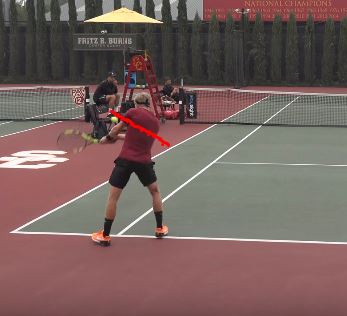
One would assume, a similar but mirrored tilt would be present on the two handed backhand.  Many tennis coaches refer to the two handed backhand as being technically the same as a lefty forehand. (RH dominant player)  However, almost the opposite is often observed.  Many players tilt their shoulders from the hitting side to the dominant side or stay relatively level at contact.  This is also grip dependent, but for the most common grips, this is consistently observed. 

Often I see recreational players in a baseball swing set up for the two handed backhand.  See Jim Courier (however his extreme grip contributes to this) In most cases this is due to the incorrect shoulder tilt that mirrors the forehand shoulder tilt.  It would seem natural to tilt in the same way that you do on the forehand…from right shoulder to left shoulder hitting side for a right handed player.  However, as you can see from the many pics attached below from high level college players and true for ATP players the shoulder tilt on the backhand does not mirror their shoulder tilt they have on the forehand, it is very similar, right shoulder up, left shoulder down on most groundstrokes regardless of forehand or backhand.

Here are examples that were not cherry picked, just routine, often first backhand frame that was captured.

Tom Fawcett Two handed backhand:


TomF_BH
Oliver Frank jumping two hand backhand:

OliverF_BH

Oliver Frank Backhand return:


oliverfrankbh

NCAA singles D1 Singles champion 2016 Nuno Borges

nonoborgesbh
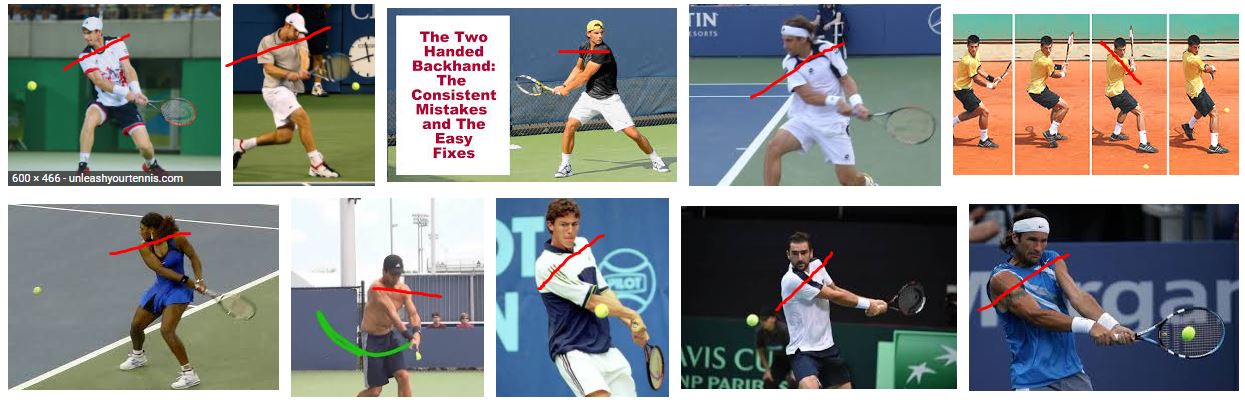
So to really make this as controlled as possible, I just Googled Pro two handed backhand images, and as you can see, the general theme is the shoulder tilt from hitting side to the dominate which is not mirrored of the forehand technique.

genericbhcollage

Why do we observe this?  There are a few reasons. The more neutral grip with the non-dominant hand partly contributes to this and because there are two hands on the racquet, dropping the dominant side shoulder to a certain extent helps open up the shoulders and give freedom to the forward swing.  This common shoulder tilt, which is rarely discussed in private lessons or group clinics, is also important to help pull the core into the court and across to help make the cross court shot more coordinated.  There are possibly other bio-mechanical factors that contribute and I would be interested in hearing your comments on this subject.


KW Tennis Nation