
This introduction tennis primer will give you the basic tennis knowledge of how to set up for a tennis stroke, how to move and receive the ball and how to strike the ball and how to recover to a neutral position. The most common shots in tennis are covered in the primer, including the forehand, the backhand, the serve and the volley. The best way to practice these strokes is to go out and find a backboard and practice serving on your own or hit with a foam ball on your garage door. You can even shadow stroke at home and video yourself to compare how your posture, balance and footwork looks compared to the instructional videos. There is no need to go to a tennis court to learn these basic foundational skills and until you can actually sustain a short rally in the driveway, you should continue refining these skills before going on court.
Ready Position
At the start of the point, the player should be in an athletic position, feet about shoulder width apart and about eighty percent of their weight on the balls of their feet with their knees bent about 20 degrees. The racquet head should be higher than the handle and held in front with their elbows just slightly in front of the torso. It is good to have some toe tapping or feet moving to be active before the first move.
Posture
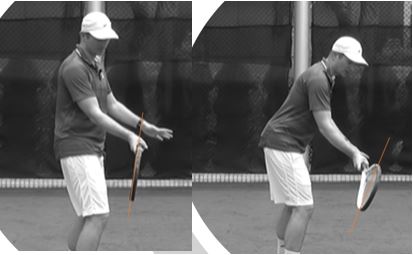
It is important to maintain consistency with your posture in the ready position, prep and walking to the ball and through the stroke and recovery. A proper posture is a slight bend of the knees, weight more towards the balls of your feet and a slight tilt forward of your upper body so your shoulders rotate on a combined linear and vertical plane and not just a linear plane.
There may be situations where dynamically changing your posture is necessary during the shot. For instance, maybe you need to rise up to a high ball, or you need to lean and reach to a ball. Note how the racquet face angle can change by simply changing your posture (spine angle).
Grips
There are fancy names for grips like Continental, Hawaiian, Eastern, Western, Semi-Western. The names aren’t as important as the basic understanding that in most all cases you want your palm facing the target at contact with the ball. Generally, this requires a continental grip for serve, overhead, volley and an eastern or weak semi-western for a forehand groundstroke.
Stances
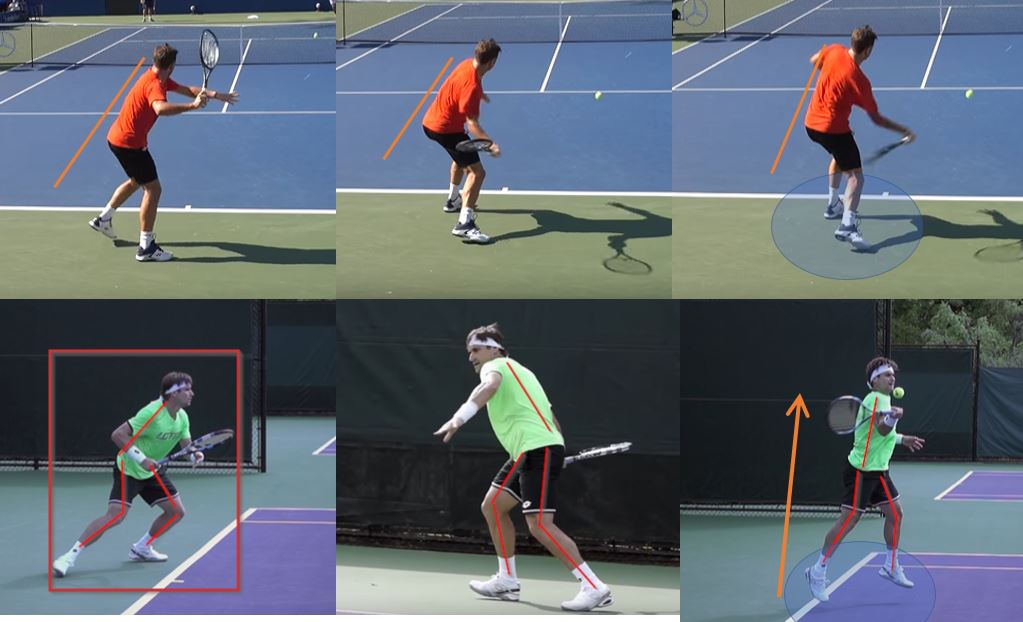
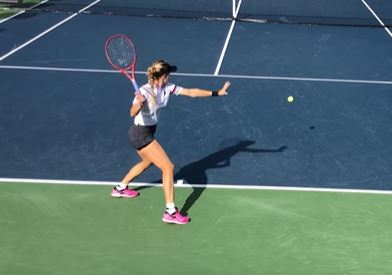
Stances are important in tennis and possibly not as critical as the footwork patterns that facilitate the efficient movement and balance for the proper strokes as well as the recovery step. I prefer to incorporate a more dynamic footwork pattern than prescribe a particular stance for each situation. The reason is that players of all levels will need to hit from various stances and prescribing only a single stance is not practical. The stances describe the position of the feet during the impact phase. Neutral stance is when the both toes are pointing sideways to the baseline and aligned with each other. As you start moving away from the center of the court, your back foot will move closer to the hitting side and your toes will start turning towards contact point. This position is know as the semi-open stance.
Split step
A small hop to gather your balance in preparation for movement to the next ball. The lifting should occur as the opponent is striking the ball and if timed right, the landing will occur as the ball comes off their strings. The landing of the split step will load up the calves and provide ground reaction force for you to move in the direction of the incoming ball in an efficient manner.
Stroke preparation
It is important to prepare early and start the unit turn as the ball travels over the net and you’ll want to be in a 50% loaded position on the ball bounce on your side of the court. The pre-load position is established by a unit turn. The unit turn is the coiling of your shoulders and hips to get sideways to the baseline. A common misconception is that the unit turn happens once you establish your hitting position. Players should practice stalking the ball in the unit turn position to get used to moving while pre-turned. At this phase the racquet should be to your side, with your non-hitting hand still on the racquet for a forehand.
Walking steps
Lateral movement to the ball will vary based on the direction and speed of the incoming ball. For many shots, a basic walking step is fine for groundstrokes for forehand and backhand. Some coaches call this stalking the ball. Walking steps help you find the proper spatial distance from the ball for a good contact position. Walking steps are initiated by a pivot, or turn of the body and walking parallel to the baseline. Use your outside foot for your spatial alignment. Walking to the forehand side, you will land the right foot (right handed players) and pivot on the left foot. Walking to the backhand, you’ll land the left foot just before striking the ball and take a small forward step with your right foot and pivot on your right foot.
Ball Striking Phase
Once your position is established for the striking phase, you’ll take the racquet back, while keeping the head and the handle on the hitting side of the body and the handle aligned vertically to the height of the ball. With a loose grip, as you swing forward, the weight and momentum of the racquet should drop the racquet head slightly below the vertical position of the ball and as you swing to contact with a slightly upward path, the racquet head will rise to contact and back in line with the handle. The stringbed should be mostly vertical at contact. Contact should be made to the side and slightly in front of the torso with the elbow slightly extended, but not reaching. The elbow should be away from the body enough that you could fit a travel pillow between your side and elbow. A swing path that finishes over the non-hitting side shoulder is recommended for the majority of groundstrokes and as the racquet head decelerates, it is advised to catch the throat of the racquet with the non-hitting hand for the forehand.
Forehand Striking Drill
Two Handed Forehand
Two hand forehand is a great option for beginning players or players looking to add more consistency to their forehand groundstroke. The Two hand forehand provides more stability and control of the racquet face during the hitting zone which can provide more control on your groundstrokes. The two hand forehand is more simple to learn and develop to a high level once you develop good footwork and receiving skills. I recommend all beginning players to try the two hand forehand!
Backhand Striking
Backhand ground strokes follow a similar approach. If hitting two handed, the contact point will be slightly more to the side than in front of the torso, because the non-hitting hand provides a quicker release of the racquet head. As you walk to contact in a pre-loaded position, initiate the swing and take back with a mini step with the right foot, then reach back with the racquet for a full take back, turn the shoulders and hips towards contact and just before reaching completely parallel to the baseline, decelerate the shoulders to allow the arms and hands to complete the swing to contact. Finish the swing over the shoulders for a high finish to add a little overspin on the ball for control.
Backhand Slice
Backhand slice can be a very versatile shot when receiving balls in various strike zones. The backhand slice can be a defensive shot or an aggressive shot depending on the height and position of the incoming ball. The backhand slice stays low and can disrupt your opponents rhythm and is often great for returning serve. The key aspects of the backhand slice include a slightly high to low and through swing path, continental grip structure, a slight downward angle of the shoulders, contact out to the side and just off the front foot, a very slight open racquet face (1-5 deg), racquet should stay on the hitting side from take back to contact and the finish is out in front of the right shoulder while extending the non-hitting hand back for balance.
Volley
The volley is ball striking before the bounce on your side of the net, typically close to the net. Grip structure is continental and the key aspects are keeping the elbow from extending behind the torso on the preparation phase and having a firm wrist through contact, initiated with laying the wrist back or wrist extension. The racquet head and handle should be moving at the same speed through contact on the volley. The volley has the most variance in face angle than any other stroke mostly due to being close to the net and using the volley to win points out right. As you learn how to volley, it is important to learn how to use your hand and wrist to angle the racquet face to send the ball to short angle targets. As you progress, you can also try adding side spin to your volleys to control them better. In this volley progression drill, we start with two hands to develop a habit of a unit turn for the forehand volley and then we move to releasing the non-dominate side hand as we swing to contact and the final drill we only use one hand for the forehand volley.
Backhand Volley
The backhand volley requires a slight suppination of the forehand and flexion of the wrist to find the best racquet face position at contact and this is often omitted from tennis coaching. It is these nuances that make tennis difficult to learn when coaches do not address these very important details that impact the ball launch angle. The backhand volley is commonly hit with a little sidespin to help control the ball to your target. Your face angle will have a wide variance due to the trajectory of the incoming ball, ball speed, ball height and your court position.
Serve – Toss, swing, footwork
In this drill we start with a toss progression and then move to striking and then discuss the footwork pattern of the serve.
Underhand serve / drop serve
The underhand serve is the best way to get started playing tennis and is not a bad strategy for better players. I’ve seen NCAA college D1 players effectively use the underhand serve as well as professional players. This video will give the the information needed on how to hit an underhand serve:
Tennis Footwork
Recovery
You’ll want to incorporate a pivot as part of the follow through and recovery. In general you want to recover close to the middle of the court after each shot and get to this position in time to regain balance and split step. Recovery phase starts as soon as the racquet decelerates from the shot and almost as part of the follow through. A well timed recovery is essential to playing higher levels of tennis. Be sure to stay on the balls of your feet, keeping low to the ground and use ground reaction force to move efficiently.
Common Faults
-Too close to the ball- you need enough spacing where your swing extends out on a 45 degree angle to the contact point. If you do not have enough space, you will end up swinging incorrectly and make your shots inconsistent.
-Open racquet face- Very common is having the racquet face too open as you progress and this limits the upward trajectory of your swing path. It is important to have the racquet face traveling in an upward direction for most ground strokes. An open racquet face can force you to swing too flat to get balls in play.
-Too short or too long of a swing- A highly debatable topic and there is no one size fits all. As a general rule, for most ground strokes you will want no less than 18 inches of forward swing path into contact. Generally, a longer swing is better and forces you to prepare earlier.
-No core rotation- The swing mirrors a hula hoop. Your shoulders, elbows and hands should be traveling along concentric circles that are inside the space of a hula hoop. There are nuances to this, but if most players follow this principal they will develop faster.
-Late preparation- The single most common problem across all recreational and junior tennis player. The racquet should be in a loaded position when the ball bounces on your side of the court. It is most common for players to start the racquet / body loading after the bounce. This will cause you to be rushed and inconsistent. Practice walking and moving in a pre-loaded position to help prevent this. See the first video.
Return of Serve-under construction
Directionals and Tactics-under construction
Situational Strokes – under construction
Lob-Under construction
Drop shot-under construction
Trajectory and the Impact on Tennis Fundamentals-under construction
 Find Your Game